
PET-CT: Advanced Molecular Imaging
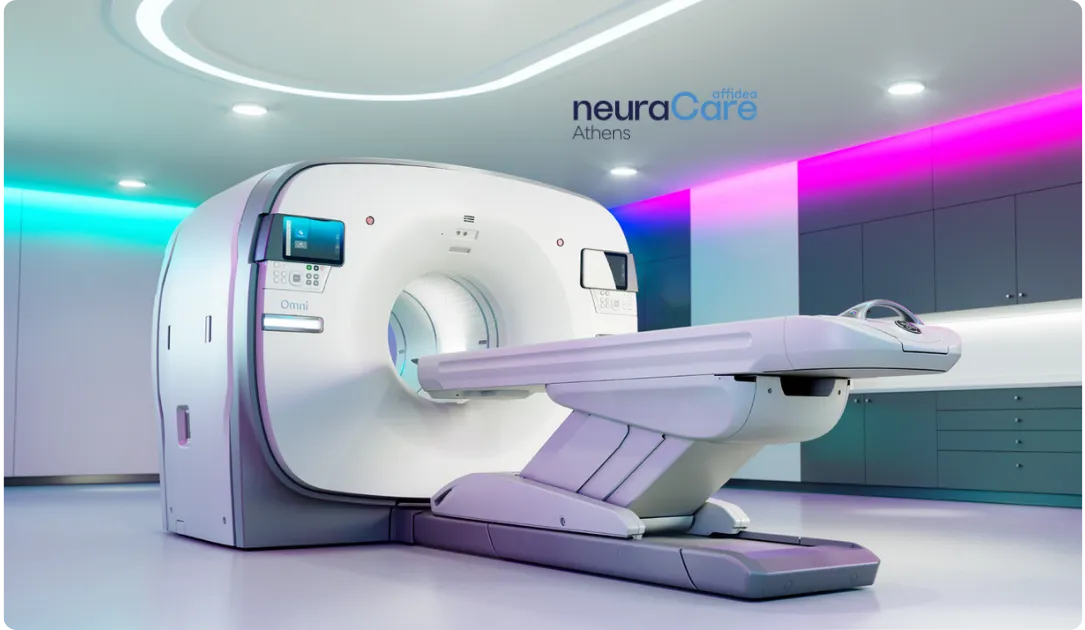
Two areas of application
Specialisation in neurology & oncology
PET-CT is used as a decisive diagnostic tool across two major fields of modern medicine. In each case, selecting the right radiotracer and providing individualised interpretation are key to an accurate diagnosis.
Neurology
Functional brain imaging for the differential diagnosis of dementia, the localisation of epileptogenic foci, and the assessment of neurodegenerative disorders.
- Differential diagnosis of dementia — Alzheimer's, FTD, DLB
- Pre-surgical work-up for refractory epilepsy
- Parkinson's disease and atypical parkinsonian syndromes
- Neurodegenerative disorders of the CNS
Neuro-Oncology & Oncology
Whole-body imaging of metabolic activity for accurate staging, identification of metastases, and monitoring of response to treatment.
- Staging of malignant neoplasms
- Monitoring of treatment response
- CNS tumours and glioma recurrence
- Differentiation between benign and malignant lesions
Our approach
Multiple radiopharmaceuticals, specialist interpretation
PET-CT combines the molecular imaging capability of Positron Emission Tomography with the anatomical precision of Computed Tomography. The choice of radiopharmaceutical is tailored to the clinical question: F-18 FDG for oncology, epilepsy and inflammatory conditions; F-18 PSMA for prostate cancer; F-18 NaF for bone metastases; F-18 FET for brain tumours; F-18 DOPA for parkinsonian syndromes; and Neuraceq (F-18 Florbetaben) for the diagnosis of Alzheimer's disease.
Under the scientific direction of Professor Sofia Chatziioannou, former Director of Nuclear Medicine at The Methodist Hospital, Baylor College of Medicine, Houston, Texas. American Board certified, with more than 100 international publications in molecular imaging.
Our applications
Specialised PET-CT protocols
Each radiopharmaceutical targets a different biological mechanism. The right choice determines the accuracy of the diagnosis.
FDG PET-CT Whole-Body
The most widely used oncological application. It exploits the high glucose uptake of malignant cells to image metabolic activity.
FDG PET-CT Brain
Functional imaging of cerebral metabolism. Different conditions show characteristic patterns of hypometabolism in specific regions.
Neuraceq® Amyloid PET-CT
Targeted imaging of β-amyloid concentration in the cerebral cortex — the hallmark neuropathological finding of Alzheimer's disease.
F-FET PET-CT Brain
An amino acid radiotracer with selective uptake by neoplastic cells in the brain. Offers significantly higher sensitivity than FDG for CNS tumours, owing to its low background uptake in healthy brain tissue.
F-DOPA PET-CT
Imaging of the dopaminergic system in the nigrostriatal pathway. Directly assesses presynaptic dopamine function — the key neurochemical finding in Parkinson's disease.
FDG PET-CT for Inflammation & Infection
FDG does not concentrate only in cancer cells — it is also taken up intensely by activated inflammatory cells. A powerful tool in difficult diagnostic cases when the focus of disease remains unclear.
F-18 PSMA PET-CT
Targeted imaging of prostate cancer through Prostate-Specific Membrane Antigen, a marker on the surface of prostate cells. Significantly higher sensitivity compared with conventional imaging methods.
F-18 NaF PET-CT Bone
A radiopharmaceutical with high affinity for bone tissue — incorporated into the hydroxyapatite of bone, revealing areas of increased bone metabolic activity. Clearly superior sensitivity and resolution compared with conventional bone scintigraphy.

ΕΟΠΥΥ-contracted service
Full PET-CT coverage through ΕΟΠΥΥ
PET-CT examinations at Affidea neuraCare are covered by ΕΟΠΥΥ — the National Organisation for the Provision of Health Services. Coverage requires a referral from the treating physician with a clear clinical indication.
Excellence should not be a privilege — specialist molecular imaging is now accessible to every insured patient.
How it works
From molecular activity to imaging
Positron Emission Tomography takes advantage of the property of certain radioactive isotopes to emit positrons. When the radiopharmaceutical reaches the target tissues, each emitted positron meets an electron, and their annihilation produces a pair of photons travelling in opposite directions.
The detector ring of the PET camera records the photon pairs simultaneously and precisely calculates their point of origin. The simultaneous CT scan provides the anatomical reference for accurate localisation.
The process
The examination, step by step
Total duration depends on the protocol, but the active imaging time is limited.
Preparation
Review of medical history and referral, glucose measurement (for FDG protocols), rest in a quiet area.
Radiopharmaceutical administration
Intravenous administration of the appropriate radiotracer according to the clinical indication.
Uptake time
Rest in a comfortable setting to allow the radiopharmaceutical to distribute through the target tissues.
Imaging
PET-CT scan in a comfortable supine position. Clinical interpretation is performed by Professor Chatziioannou.

Director of Nuclear Medicine
Prof. Sofia Chatziioannou
Professor of Nuclear Medicine, NKUA · American Board Certified
Professor of Nuclear Medicine and an internationally recognised expert in molecular imaging. With specialty and subspecialty training at Baylor College of Medicine and previous appointments as Director of Nuclear Medicine at The Methodist Hospital in Houston, she has contributed substantially to the development of advanced molecular imaging methods in Greece.
Frequently Asked Questions
Before your examination
The most common questions from patients planning a PET-CT.
Is the examination dangerous because of radiation?
Is the examination covered by ΕΟΠΥΥ?
How long does the visit take in total?
Is any preparation required before the examination?
What is the difference between PET-CT and MRI or CT?
Is there a risk of allergic reaction or claustrophobia?
Do I need to stop my medication?
When will I receive the results?
Book an appointment
Schedule your PET-CT
Complete the form below and the Affidea neuraCare team will contact you within one business day to confirm the appropriate examination and provide you with detailed preparation instructions.
Saturday & Sunday closed